
Explanation of staff augmentation services and their relevance in 2020, highlighting benefits and applications.

What Is Staff Augmentation Service and How Does It Work?

In today’s rapidly evolving business landscape, finding the right talent at the right time has become a major challenge. Many organizations struggle with the balance between speed, skill, and scalability especially when handling multiple projects or scaling digital teams. That’s where Staff Augmentation Service comes into play.

It’s a flexible, cost-effective hiring model that allows businesses to temporarily expand their teams with qualified professionals — without the long-term commitment or overhead of traditional hiring. In 2025, as companies across industries face increased competition and talent shortages, staff augmentation is quickly becoming a strategic necessity rather than an option.

What Is Staff Augmentation Service?

Staff augmentation is a workforce solution that helps businesses strengthen their in-house teams with external experts for specific projects, skill gaps, or tight deadlines. Instead of hiring full-time employees, companies can “augment” their existing staff with vetted talent — from developers and designers to data scientists and QA testers.

In simple terms, it’s like plugging in the exact skills you need, right when you need them.

How Does Staff Augmentation Work?

The process of staff augmentation is designed for agility and efficiency. Here’s how it typically works:

  1. Needs Assessment: The company identifies which skills or roles are missing within their current team.
  2. Talent Sourcing: The staff augmentation provider (like Datics.ai) finds suitable professionals that match your requirements.
  3. Onboarding & Integration: The selected professionals join your in-house team, working under your management and following your processes.
  4. Project Execution: The augmented staff contributes directly to your goals while maintaining seamless collaboration with your team.
  5. Project Completion or Transition: Once the project is complete, the augmented staff can either transition out or continue for future projects.

This streamlined process ensures that organizations stay productive and adaptable, without the bottlenecks of traditional hiring cycles.

Why Businesses Are Turning to Staff Augmentation in 2025

The global business environment has changed dramatically since the pandemic. Remote work, rapid digital transformation, and global competition have made flexible workforce models essential.

In 2025, companies are using staff augmentation to:

  • Quickly fill skill gaps in AI, data analytics, and software development.
  • Scale teams up or down depending on project demands.
  • Access global talent without geographic limitations.
  • Control costs and reduce risks associated with full-time employment.
  • Accelerate time-to-market for new products or solutions.

This model allows enterprises to focus on innovation and growth, while leaving talent acquisition and management to experts.

Types of Staff Augmentation Services

Not all staff augmentation models are the same. Depending on your needs, there are several options:

  • Short-Term Augmentation: Perfect for urgent project needs or temporary replacements.
  • Long-Term Augmentation: For ongoing projects or sustained skill support.
  • Skill-Based Augmentation: Focused on specific expertise like AI engineering, UX design, or data science.
  • Project-Based Augmentation: When an entire project team is required under your supervision.

Each model offers flexibility to fit different business goals — from startups needing specialized developers to enterprises scaling complex digital operations.

Benefits of Using Staff Augmentation Services

The advantages of staff augmentation extend far beyond cost savings. Here’s what makes it truly transformative:

  • Access to Global Expertise: Work with top talent from anywhere in the world.
  • Faster Project Delivery: Quickly bring in skilled professionals to meet tight deadlines.
  • Operational Flexibility: Scale your workforce according to project demands.
  • Reduced Hiring Costs: Avoid lengthy recruitment processes and employment benefits.
  • Focus on Core Business Goals: Let experts handle specific technical areas while your team focuses on strategy.

Organizations like Datics.ai help bridge the gap between talent shortages and project success by providing vetted professionals ready to integrate seamlessly with your team.

Staff Augmentation vs. Traditional Hiring

Traditional hiring is time-consuming, expensive, and rigid. It often requires weeks of recruitment, onboarding, and training before productivity begins. In contrast, staff augmentation offers instant access to experienced talent with zero onboarding delay.

Aspect Traditional Hiring Staff Augmentation
Time to Hire Long (4–8 weeks) Quick (1–2 weeks)
Cost High Flexible
Flexibility Low High
Skill Access Local Global
Project Control Limited Full

This difference is exactly why so many organizations are transitioning toward augmented models in 2025.

How Staff Augmentation Supports Innovation

Innovation thrives on speed, collaboration, and adaptability — and staff augmentation enables all three. By bringing specialized experts on board quickly, businesses can experiment with new technologies, accelerate development cycles, and reduce downtime.

In fact, according to research, companies using hybrid talent models are 40% faster in launching new digital initiatives. This aligns with Datics.ai’s innovation philosophy — transforming ideas into scalable business outcomes. You can explore this concept further in their article: How Innovation Transforms Challenges Into Opportunities.

Challenges of Staff Augmentation (and How to Overcome Them)

While staff augmentation offers numerous benefits, it’s not without challenges — such as managing remote collaboration, aligning workflows, or ensuring consistent communication.

To overcome these issues:

  • Set clear expectations and KPIs from day one.
  • Use collaboration tools for real-time communication.
  • Choose a trusted provider like Datics.ai that ensures cultural fit and expertise.

A reliable augmentation partner turns potential challenges into opportunities for efficiency and innovation.

The Future of Staff Augmentation in 2025 and Beyond

The future of work is hybrid, agile, and talent-driven. With AI-driven platforms, global collaboration tools, and remote-first business models, staff augmentation services are becoming central to digital transformation strategies.

In 2025, expect to see businesses rely even more on flexible staffing models — not as a backup plan, but as a strategic growth lever.

FAQs

1. What does staff augmentation mean?

It’s a flexible hiring model that allows businesses to add skilled professionals to their existing teams temporarily.

2. How does staff augmentation differ from outsourcing?

In staff augmentation, external professionals work under your management, while outsourcing transfers full project responsibility to an external team.

3. Is staff augmentation cost-effective?

Yes, it reduces hiring costs, training expenses, and overhead while maintaining high productivity.

4. What industries benefit most from staff augmentation?

IT, fintech, healthcare, e-commerce, and manufacturing companies benefit greatly from this model.

5. How can Datics.ai help with staff augmentation?

Datics.ai connects enterprises with pre-vetted professionals through a transparent, scalable process that accelerates growth.

Author Bio 

Written by the Datics.ai Editorial Team — a group of tech experts passionate about digital innovation, AI-driven transformation, and agile workforce solutions. Datics.ai empowers global businesses through cutting-edge staff augmentation, automation, and software development services designed for the future of work.
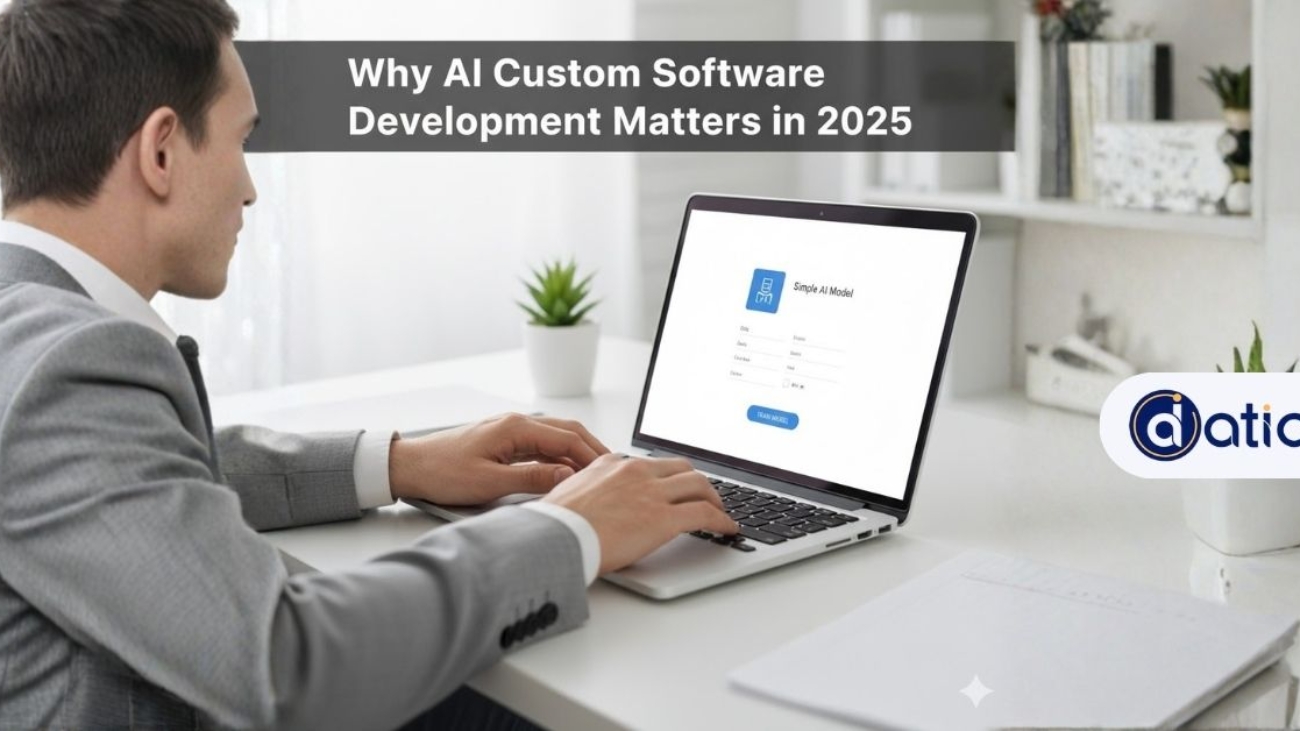

A man works on a laptop at a desk with the screen showing a login page; a banner reads, "Why AI Custom Software Development Matters in 2025.

AI Custom Software Development: Why It’s No Longer Optional in 2025

In 2025, businesses are operating in an ecosystem where data never sleeps, markets shift overnight, and customer expectations evolve faster than ever. Off-the-shelf software can no longer keep up. Companies need intelligent, adaptive systems that grow with their operations — and that’s where AI Custom Software Development comes in.

AI-driven solutions aren’t a luxury anymore; they’ve become the foundation of modern competitiveness. From automating decision-making to improving customer engagement, custom AI software empowers businesses to move faster, smarter, and more efficiently than ever before.

Understanding AI Custom Software Development

AI custom software development is the process of building tailored digital systems that use artificial intelligence to solve unique business problems. Unlike generic software that provides static features, custom AI applications evolve with data, learn from patterns, and continuously improve over time.

For example, a retail chain may develop an AI-powered forecasting tool that predicts seasonal demand with pinpoint accuracy. Meanwhile, a logistics company might use a custom AI model to optimize route planning and fuel efficiency. Each solution is purpose-built — designed around specific business goals and real-world challenges.

Why Generic Solutions Aren’t Enough Anymore

Businesses once relied on one-size-fits-all software to manage workflows and customer data. While these tools offered structure, they lacked adaptability. In today’s world of constant digital transformation, every enterprise faces challenges that demand unique intelligence.

Generic software:

  • Struggles to integrate diverse data sources
  • Can’t scale dynamically with changing demands
  • Requires heavy manual intervention to stay relevant

Custom AI software, on the other hand, adapts in real-time — learning from operational data, predicting outcomes, and suggesting improvements without human micromanagement. It doesn’t just execute commands; it thinks alongside the organization.

The Rising Need for AI Custom Software in 2025

The need for AI-powered customization stems from three fundamental business realities: speed, complexity, and competition.

1. Business Speed:

Markets evolve daily. Companies that can analyze trends and act faster dominate their sectors. AI software enables real-time insights, helping leaders make data-backed decisions without delays.

2. Operational Complexity:

Modern enterprises operate across global networks, facing multifaceted problems that static systems can’t handle. AI breaks down complexity by automating decision flows and spotting inefficiencies before they escalate.

3. Competitive Pressure:

With competitors embracing AI, those who resist automation fall behind. In 2025, innovation speed is directly linked to how deeply AI is embedded in business strategy.

Key Benefits of AI Custom Software Development

1. Smarter Automation

Custom AI systems automate repetitive, time-consuming tasks with precision. From financial reconciliations to customer query responses, automation powered by AI reduces human error while freeing teams to focus on innovation.

2. Predictive Intelligence

Rather than reacting to problems, AI software predicts them. For example, manufacturing AI can foresee equipment failures, while retail algorithms can anticipate consumer demand. Businesses move from reactive to proactive mode.

3. Cost Efficiency

AI-driven optimization leads to measurable cost savings. By reducing redundant operations and maximizing resource use, businesses achieve higher output at lower expense. This principle is explained in detail in this Datics.ai blog exploring how intelligent automation improves efficiency without cutting quality.

4. Personalization & Customer Engagement

AI custom software tailors experiences to each user, from personalized marketing campaigns to product recommendations. In 2025, customer loyalty depends on personalization, and AI delivers it seamlessly.

5. Scalable Growth

Unlike rigid off-the-shelf tools, AI systems scale with your data, team, and goals. Whether you’re expanding into new markets or introducing new services, custom AI software evolves without heavy restructuring.

Industry Examples: AI in Action

AI-driven transformation isn’t limited to a single domain — it’s happening across industries.

  • Healthcare: Predictive AI assists in early diagnosis, improving patient outcomes.
  • Finance: Fraud detection models monitor millions of transactions in real-time.
  • Retail: Personalized AI engines boost customer retention and sales conversion.
  • Logistics: Route optimization and demand forecasting cut operational costs.
  • Manufacturing: Predictive maintenance prevents costly production delays.

Each case demonstrates how customized AI software directly aligns with an organization’s unique needs and data environment something generic systems can’t replicate.

How Datics.ai Approaches Custom AI Development 

Industry innovators like Datics.ai approach AI software development through a blend of data science, engineering precision, and human insight. Their process emphasizes co-creation — working closely with clients to identify problems that truly warrant AI intervention.

Rather than applying AI for novelty, they focus on measurable impact — improved productivity, reduced costs, and smarter scalability. By integrating AI seamlessly into existing workflows, they ensure that intelligence enhances, not replaces, human creativity.

Challenges and Considerations

While the benefits are undeniable, building AI software requires careful planning:

  • Data Readiness: Quality data fuels AI. Inconsistent or biased datasets can lead to unreliable predictions.
  • Integration Complexity: Aligning AI systems with legacy infrastructure takes technical finesse.
  • Ethical Transparency: Responsible AI demands fairness, privacy protection, and explainability.
  • Skill Requirements: Developing AI models involves multidisciplinary expertise in machine learning, cloud architecture, and user experience.

The key is to partner with experienced teams who understand both the technology and the business impact behind it.

The Future of AI Custom Software Development

As AI becomes the backbone of digital infrastructure, custom solutions will define business success. In 2025 and beyond, the integration of generative AI, self-optimizing algorithms, and real-time adaptive systems will reshape how enterprises operate.

The future lies in AI-native organizations — companies that embed AI across every layer of their operations, from decision support to customer interaction. Businesses that begin investing in tailored AI solutions today are setting themselves up for sustained competitive advantage tomorrow.

FAQs

1. What makes AI custom software different from standard software?

Custom AI software adapts and learns from your business data, making it more efficient and relevant than one-size-fits-all applications.

2. How does AI reduce business costs?

By automating repetitive tasks, minimizing errors, and optimizing workflows, AI significantly lowers operational expenses.

3. Is AI software suitable for small businesses?

Yes. With scalable frameworks and cloud AI tools, even small enterprises can adopt cost-effective AI solutions.

4. What industries benefit most from AI custom software?

Sectors like healthcare, finance, retail, and logistics see major returns from AI automation and prediction models.

5. How can a company start its AI journey?

Begin with a clear problem statement, validate ROI, and collaborate with experts who align technology with strategy.

Author Bio

Written by the editorial team at Datics.ai — experts in designing scalable, intelligent, and adaptive software solutions that bridge innovation with business practicality. Datics.ai helps companies harness AI’s full potential through responsible, transparent, and goal-oriented software development.

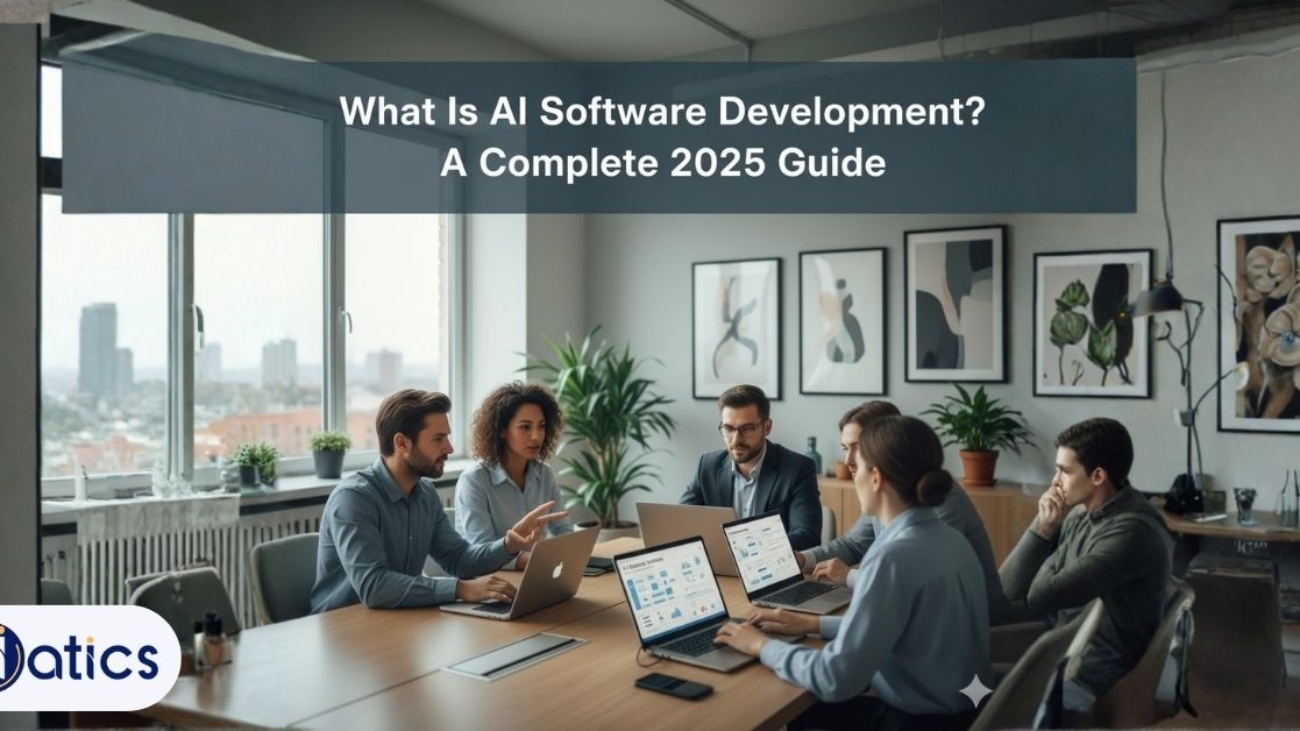
Five people sit at a conference table with laptops in a modern office; a banner reads, "What Is AI Software Development? A Complete 2025 Guide.

What is Ai Software Development? A Complete 2025 Guide for Businesses

Artificial Intelligence (AI) is no longer an experimental concept—it’s the foundation of modern business transformation. In 2025, companies across every industry are leveraging AI Software Development to automate decisions, streamline processes, and discover insights hidden in massive data streams.

This guide breaks down what AI software development really means, how it differs from traditional coding, and why it’s become a critical driver of innovation for businesses worldwide.

Understanding AI Software Development

AI software development is the process of designing, building, and deploying software systems that can learn from data and make intelligent decisions. Unlike traditional software, which follows predefined instructions, AI systems adapt over time based on new information.

In simpler terms, it’s about creating software that thinks—identifying patterns, predicting outcomes, and improving automatically without human input for every update.

How AI Software Development Works

The journey begins with a clear business challenge: inefficiencies, manual bottlenecks, or complex decision points. Developers then collect relevant data, train AI models, test them rigorously, and integrate them into real-world applications.

For instance, a logistics company may use AI to predict delivery delays using historical and real-time data, while a healthcare startup might build an AI model to analyze radiology scans faster than traditional tools.

Once deployed, these systems don’t stop learning—they evolve as they process more data, continuously enhancing performance and accuracy.

AI Software vs. Traditional Development

Traditional software relies on hardcoded logic: if X happens, do Y. In contrast, AI-driven software analyzes patterns and decides based on probabilities rather than rigid rules.

This adaptability gives businesses a unique edge—AI systems can handle uncertainty, learn from mistakes, and make nuanced decisions in dynamic environments where fixed logic falls short.

Imagine comparing a standard reporting dashboard to one powered by AI: instead of just showing past numbers, the AI version predicts next month’s performance and explains what’s driving the trend.

Why Businesses Are Moving Toward AI Software

The shift isn’t just about automation; it’s about strategic agility. AI-driven systems allow companies to forecast outcomes, personalize customer journeys, and reduce human error.

By leveraging AI Custom Software Development, companies can even cut operational costs while maintaining performance something explored in-depth in this blog post How Can AI Custom Software Development Reduce Costs Without Hurting Efficiency

 About.

As businesses in 2025 face tighter margins and more data than ever, AI helps them operate smarter, not harder.

Real Impact Across Industries

From retail to healthcare, AI development is redefining how value is created.

  • In finance, AI detects fraudulent transactions instantly.
  • In manufacturing, predictive systems anticipate maintenance before breakdowns occur.
  • In e-commerce, intelligent engines recommend products customers actually want.
  • In healthcare, AI models accelerate diagnosis with precision unseen before.

These examples prove one thing: when businesses pair innovation with data-driven intelligence, they unlock efficiency that static systems simply can’t match.

Challenges in Building AI Software

Despite its promise, AI development is not without hurdles. Poor data quality, integration issues, and skill shortages can limit performance. Ethical considerations—like transparency and bias—also play a major role.

That’s why trusted partners like Datics.ai emphasize transparent processes, clear governance, and continuous model improvement to ensure AI systems remain ethical, explainable, and sustainable in the long term.

The Future of AI Software Development in 2025 and Beyond

AI is becoming embedded in the entire software lifecycle—from code generation to automated quality testing. The rise of no-code AI builders, AI agents, and autonomous model training systems will further shorten development cycles while expanding accessibility to non-technical users.

Businesses that integrate AI early will gain compound advantages: faster operations, sharper predictions, and better customer relationships. In a world run by data, intelligence is the ultimate differentiator.

Final Words

AI software development isn’t just about algorithms—it’s about transformation. In 2025, every forward-thinking business must view AI as a partner, not just a tool. The future belongs to those who can merge human creativity with machine intelligence, turning complex data into real competitive advantage.

FAQs

1. What is AI software development?

It’s the process of building adaptive software systems that learn and make intelligent decisions using machine learning and data-driven logic.

2. How does AI improve business operations?

AI automates workflows, predicts outcomes, and enables more accurate and faster decisions.

3. What industries benefit the most from AI software?

Healthcare, retail, logistics, finance, and manufacturing currently lead adoption.

4. Can small businesses afford AI development?

Yes—modern frameworks and cloud solutions make AI integration accessible and scalable.

5. How can I start with AI software development?

Begin with a small pilot focused on one measurable problem, then scale as results validate ROI.

Author Bio

Written by the editorial team at Datics.ai — combining deep expertise in AI-driven software innovation with a mission to make technology human-centric, transparent, and impactful for modern businesses.

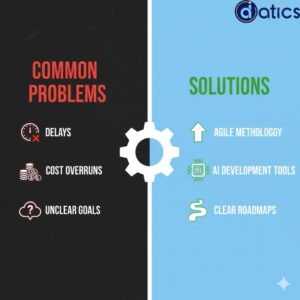
A visual representation highlighting the major challenges faced in software product development processes.

Ideation Services: Solving the Biggest Challenge in Turning Ideas Into Products

Transforming a brilliant idea into a market-ready product is rarely straightforward. Many startups and even established enterprises face roadblocks such as lack of clarity, scattered strategies, and inefficient execution. This is where Ideation Services play a critical role—helping businesses bridge the gap between concept and creation.

In this article, we’ll explore the problem-solving power of ideation, how it reduces risks, and why it is becoming essential in the fast-paced innovation-driven market.

Why Businesses Struggle to Turn Ideas Into Products

Every product begins as an idea, but most ideas fail to evolve into viable offerings. Some common challenges include:

  • Lack of market validation
  • Poor alignment between stakeholders
  • Limited technical expertise
  • Unclear business goals
  • Time and budget overruns

Without a structured framework, even the most promising concepts often stall before reaching customers.

What Are Ideation Services?

Ideation services provide businesses with a systematic process for brainstorming, validating, and shaping ideas into scalable solutions. This involves:

  • Market research and validation
  • Customer-centric design thinking
  • Technical feasibility analysis
  • Prototyping and MVP (Minimum Viable Product) development
  • Roadmap planning

By using ideation frameworks, organizations can streamline decision-making, avoid costly mistakes, and speed up time-to-market.

The Problem-Solving Role of Ideation Services

1. Aligning Business Goals With Market Needs

Ideation workshops ensure that product ideas are rooted in real-world demand, not assumptions. Businesses can avoid wasting resources by validating ideas against customer pain points.

2. Reducing Development Risks

Through early prototyping and MVP creation, companies minimize the risk of investing heavily in unproven solutions.

3. Accelerating Innovation

Instead of endless brainstorming cycles, ideation services channel creativity into structured workflows—helping businesses act faster than competitors.

4. Building Cross-Functional Collaboration

Ideation brings together stakeholders, designers, engineers, and decision-makers to ensure shared understanding from the start.

5. Enhancing Scalability

Ideas are filtered through feasibility checks, ensuring they can evolve into long-term scalable solutions.

AI and Ideation: A New Dimension

Modern AI Software Development has transformed ideation processes by enabling predictive analysis, market simulations, and automation. Companies like Datics.ai, while staying neutral in their approach, provide innovative solutions that integrate AI into ideation to make problem-solving faster and more reliable.

For a deeper look at how AI is already solving business challenges, check out this resource on AI Software Development in Action.

Ideation Services in Action: From Concept to Product

Here’s how a structured ideation process typically unfolds:

  1. Discovery Session – Identifying problems and opportunities.
  2. Research & Validation – Testing the idea against real customer needs.
  3. Brainstorming Workshop – Generating creative solutions.
  4. Prototyping – Designing a simple, testable version.
  5. Testing & Feedback – Gathering insights from early users.
  6. Product Roadmap – Aligning the vision with long-term growth.

This end-to-end approach helps businesses not only refine their ideas but also move toward execution with confidence.

Why Ideation Services Are Crucial Today

The innovation landscape is moving faster than ever. Without structured ideation, businesses risk:

  • Building products nobody wants
  • Falling behind competitors
  • Burning through resources with no ROI

With professional ideation support, companies can turn challenges into opportunities and ideas into revenue-generating products.

FAQs

1. What industries benefit most from ideation services?

Startups, SaaS companies, healthcare, retail, and enterprises launching digital products benefit greatly.

2. How do ideation services reduce risks?

They validate concepts early, avoiding heavy investments in untested ideas.

3. Can AI improve ideation services?

Yes, AI adds predictive analysis, automated research, and smarter prototyping.

4. What’s the difference between brainstorming and ideation services?

Brainstorming is creative; ideation services combine creativity with structured validation and execution.

5. Do ideation services help only startups

No, enterprises also use them to innovate, pivot, or modernize existing products.

A visual representation highlighting the major challenges faced in software product development processes.

The Biggest Problems in Software Product Development (And How to Fix Them)

Software product development is the backbone of modern businesses, but it rarely comes without challenges. From unclear requirements to rising costs and missed deadlines, many organizations struggle to turn ideas into successful, scalable products. Understanding these problems—and learning how to solve them—can mean the difference between a failed launch and a product that drives real business value.

In this blog, we’ll break down the biggest problems in software product development and explore practical solutions that help companies deliver faster, smarter, and more efficiently.

1. Unclear Requirements and Vision

One of the most common problems in software product development is a lack of clarity around product goals. Teams often begin coding without a well-defined roadmap, leading to scope creep, endless revisions, and wasted resources.

How to Fix It:

  • Start with a clear product vision document.
  • Involve stakeholders early in the planning stage.
  • Use Agile methodologies to keep requirements flexible but controlled.
  • Employ tools like Jira, Trello, or ClickUp for requirement tracking.

Clarity at the start ensures that every decision made during development aligns with business objectives.

2. Poor Communication Across Teams

In product development, collaboration between design, engineering, marketing, and stakeholders is crucial. A lack of communication can lead to misunderstandings, missed deadlines, and inconsistent features.

How to Fix It:

  • Use collaboration platforms like Slack, Asana, or Microsoft Teams.
  • Encourage daily stand-ups and sprint reviews.
  • Establish clear ownership for tasks and deliverables.
  • Foster a culture of transparency and open dialogue.

When communication flows freely, software development becomes smoother and faster.

3. Rising Costs and Budget Overruns

Budget overruns are a nightmare for startups and enterprises alike. Costs often spiral when projects drag on, new features are added last-minute, or the scope keeps expanding.

How to Fix It:

  • Create a detailed project budget with milestones.
  • Implement Agile and MVP (Minimum Viable Product) approaches.
  • Monitor costs continuously using project management software.
  • Outsource or partner strategically to reduce overhead.

Companies that focus on cost control without cutting quality build sustainable and scalable products.

4. Slow Time-to-Market

With competition growing daily, delays in launching can mean losing your advantage. Traditional development models are often too slow to keep up with customer demands.

How to Fix It:

  • Leverage AI-driven tools for automated testing, coding assistance, and predictive analytics.
  • Prioritize feature development that aligns with customer needs.
  • Break development into smaller, iterative sprints for faster delivery.

Adopting modern practices like Software Product Development ensures speed without sacrificing quality.

5. Lack of Scalability

Many businesses launch products that cannot handle growth. When software fails to scale, it limits revenue potential and frustrates users.

How to Fix It:

  • Build with scalability in mind from day one.
  • Use cloud-native architectures like AWS, Azure, or Google Cloud.
  • Prioritize modular design for easier upgrades.
  • Test under simulated high-traffic conditions.

Scalable products grow with your business rather than holding it back.

6. Struggles Between Traditional and Modern Methods

Another growing issue is the gap between traditional software development models and modern approaches like AI-driven development. Traditional methods often take longer and lack flexibility, while AI-powered strategies accelerate innovation.

How to Fix It:

Adopt hybrid approaches that bring together the reliability of traditional frameworks with the efficiency of AI-driven tools. For more insights, you can explore our in-depth blog: AI Product Development vs. Traditional MethodsThis balance ensures companies get the best of both worlds—speed and reliability.


FAQs

1. What is the biggest challenge in software product development?

The biggest challenge is often unclear requirements, which cause delays and unnecessary costs.

2. How can businesses reduce development costs?

Using MVP strategies, Agile frameworks, and AI-driven automation helps cut costs significantly.

3. Why do many products fail to scale?

Most products fail to scale because scalability wasn’t considered during the design stage.

4. How does AI improve product development?

AI enhances speed, accuracy, and automation in areas like testing, coding, and decision-making.

5. What’s the fastest way to bring a product to market?

Prioritizing essential features, using Agile sprints, and leveraging AI tools accelerates time-to-market.

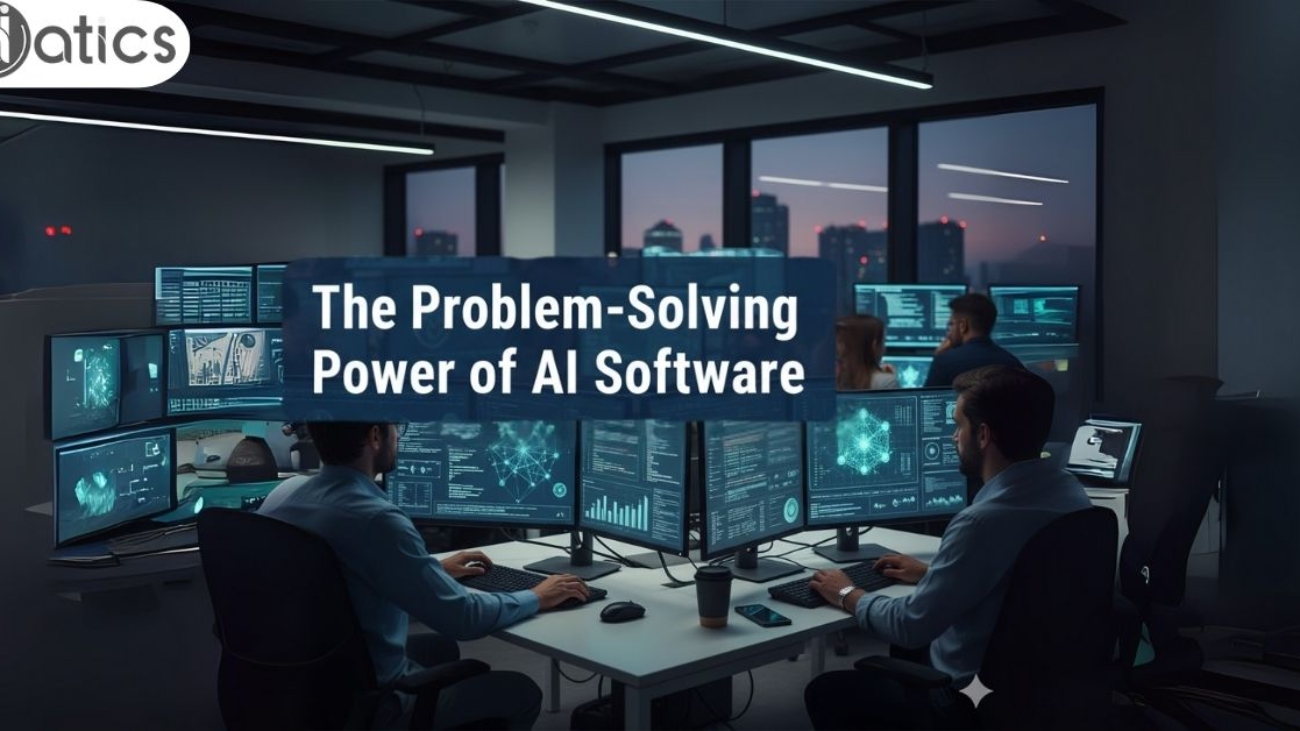
Visual representation of software demonstrating its capabilities in addressing complex problems.

The Problem-Solving Power of AI Software: What You Need to Know

Artificial Intelligence is no longer just a futuristic concept—it has become a practical tool reshaping industries across the globe. From healthcare and finance to retail and logistics, AI software is solving problems that once took months or even years to address. But what exactly makes AI so powerful in problem-solving, and how does it compare to traditional methods?

This article explores the problem-solving power of AI software, why it matters, and how organizations are leveraging it today. Whether you’re a startup founder, enterprise leader, or technology enthusiast, understanding the impact of AI is essential for staying ahead in today’s digital-first economy.

What Is AI Software?

AI software refers to applications that use machine learning, natural language processing, computer vision, and automation to perform tasks that typically require human intelligence. Instead of just following programmed rules, AI adapts, learns, and improves continuously.

Examples include:

  • Chatbots that provide customer support 24/7

  • Predictive analytics for forecasting demand

  • Fraud detection systems in banking

  • AI-driven recommendation engines in e-commerce

Unlike traditional software, AI evolves with data, making it a unique tool for solving complex, ever-changing problems.

Why Problem-Solving with AI Software Matters

Businesses face challenges that are often too vast or dynamic for manual solutions. Data grows at exponential rates, customer expectations shift quickly, and competition demands rapid innovation. AI solves these problems faster by:

  • Automating repetitive processes

  • Delivering real-time insights from large datasets

  • Predicting future trends with high accuracy

  • Enabling personalization at scale

  • Reducing human errors in critical tasks

For organizations, the question is no longer if AI can solve problems but rather how to use it effectively.

Key Areas Where AI Software Solves Problems Faster

1. Healthcare and Diagnostics

AI tools analyze medical images, predict diseases, and even recommend treatment plans. They reduce diagnostic errors and accelerate patient care.

2. Finance and Fraud Detection

Banks rely on AI systems to monitor transactions in real-time, detecting fraudulent activity within seconds.

3. Supply Chain and Logistics

AI-powered demand forecasting helps companies optimize inventory and prevent costly overstocking or shortages.

4. Customer Experience

AI-driven chatbots and recommendation engines enhance customer satisfaction by providing instant, personalized solutions.

5. Software Development

In fields like AI Software Development, companies leverage automation and machine learning to speed up coding, testing, and deployment—helping businesses scale faster while maintaining quality.

AI Software vs. Traditional Approaches

Traditional Problem-Solving

  • Relies heavily on human intervention

  • Slower due to manual processes

  • Limited ability to scale quickly

  • Effective for compliance-heavy industries

AI-Powered Problem-Solving

  • Uses automation and predictive analytics

  • Faster, data-driven decisions

  • Highly scalable with minimal overhead

  • Continuously improves with data

The difference is not about replacing humans but empowering them with smarter tools.

Real-World Applications of AI Problem-Solving

AI is not theory—it’s in action today. For example, retail companies use AI to optimize pricing strategies in real-time, while logistics firms rely on AI to reroute deliveries during disruptions.

As highlighted in this article on AI software development in action, AI doesn’t just automate—it provides practical, scalable solutions to the biggest challenges businesses face. Companies like Datics.ai are leading the way by helping organizations integrate AI seamlessly into their processes.

Benefits of AI Software in Problem-Solving

  • Faster time-to-market for products and services

  • Smarter decision-making with predictive insights

  • Lower operational costs through automation

  • Improved accuracy by reducing human error

  • Enhanced scalability for growing organizations

Challenges in Adopting AI Software

While powerful, AI is not without challenges. Businesses often face:

  • Lack of in-house expertise

  • High initial implementation costs

  • Data privacy and compliance concerns

  • Integration with legacy systems

The solution is to partner with technology experts who understand both the technical and business aspects of AI implementation.

The Future of AI Software in Problem-Solving

Looking ahead, AI will become more accessible, transparent, and aligned with ethical standards. Instead of being limited to large enterprises, small and mid-sized businesses will also harness AI to solve real-world problems at scale.

AI won’t replace traditional problem-solving entirely—it will enhance human creativity and decision-making, ensuring problems are solved with speed, accuracy, and innovation.

FAQs

1. What makes AI software different from traditional software?

AI software adapts and learns from data, while traditional software follows fixed rules.

2. Can AI software reduce costs for businesses?

Yes, by automating repetitive tasks and improving efficiency, AI lowers operational expenses.

3. What industries benefit most from AI software?

Healthcare, finance, retail, logistics, and technology see the biggest impact.

4. Is AI software safe to use in business operations?

Yes, when implemented with proper compliance and data protection measures.

5. How does AI improve customer experience?

AI enables personalization, faster responses, and predictive service improvements.

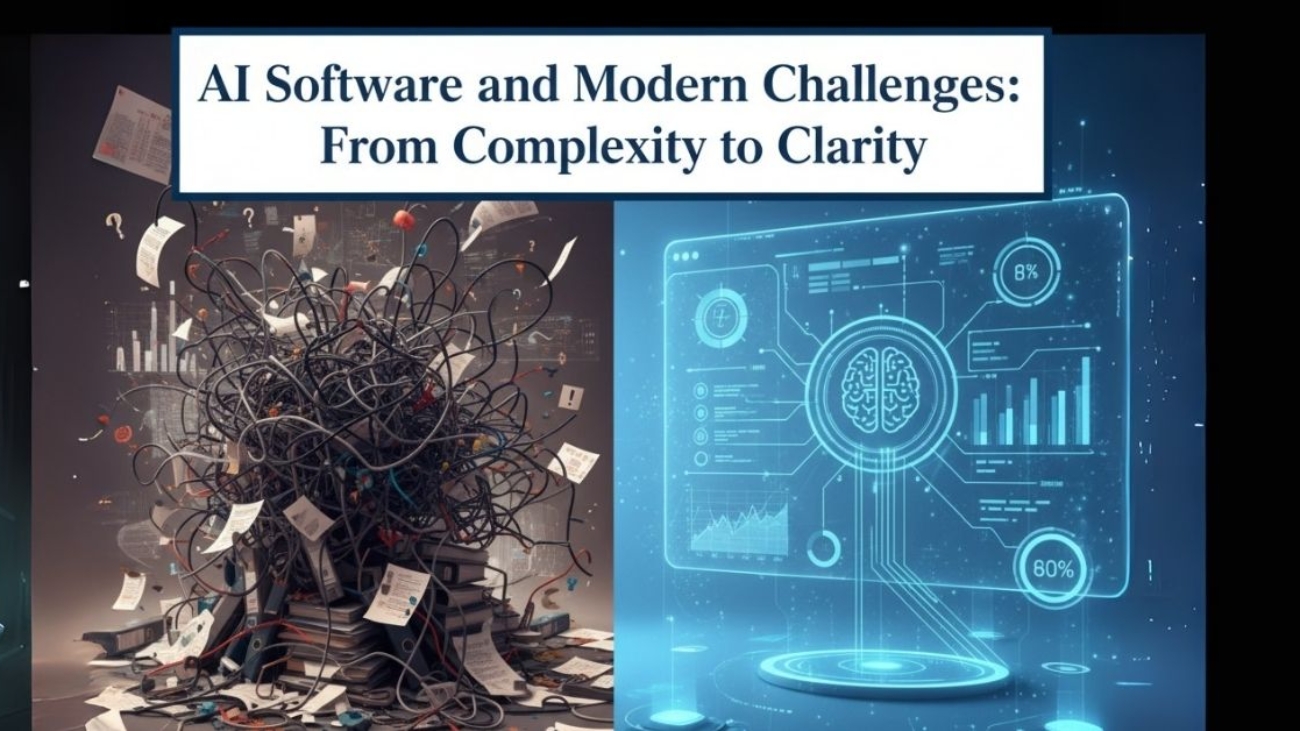
AI software addressing modern challenges, transforming complexity into clarity for enhanced understanding and decision-making.

AI Software and Modern Challenges: From Complexity to Clarity

Modern businesses face challenges that are bigger, faster, and more complex than ever before. From handling massive datasets to delivering seamless customer experiences, companies are under pressure to move quickly without sacrificing quality. This is where AI software Development  emerges as a problem-solver, helping organizations cut through complexity and find clarity in decision-making, operations, and growth strategies.

But what does this really mean for businesses today? Can AI software truly make things simpler, or is it just another layer of complexity? This article explores the role of AI in solving modern challenges and how businesses can harness it to create clarity and impact.

Understanding the Complexity of Modern Business Challenges

Today’s organizations are navigating:

  • Data Overload: Millions of interactions, transactions, and records that need real-time analysis.
  • Market Uncertainty: Rapid shifts in customer behavior and unpredictable global trends.
  • Operational Inefficiency: Manual processes that slow down innovation and scalability.
  • Customer Expectations: Consumers demand faster, smarter, and more personalized services.

Traditional approaches are struggling to keep up. That’s why companies are now turning to AI software development to not only manage but also simplify these challenges.

How AI Software Brings Clarity

AI-driven tools transform complex problems into actionable insights. Here’s how:

1. Data Simplification

AI organizes raw, unstructured data into clear patterns and predictions, helping leaders make smarter decisions without drowning in spreadsheets.

2. Automation of Repetitive Tasks

Instead of teams spending hours on routine tasks, AI automates them—freeing human talent for creative and strategic work.

3. Predictive Analytics for Strategy

By learning from past data, AI forecasts trends, reduces uncertainty, and guides companies toward better growth opportunities.

4. Enhanced Customer Experience

From chatbots to personalization engines, AI enables businesses to engage customers with speed and precision.

5. Scalability Made Simple

AI allows businesses to grow operations without proportionally increasing resources, reducing both costs and complexity.

AI Software vs. Traditional Problem-Solving Approaches

Traditional methods often rely on human analysis, lengthy development cycles, and manual troubleshooting. While reliable in structured environments, they are too slow for today’s fast-paced market.

By contrast, AI software uses real-time analysis, machine learning, and intelligent automation to anticipate problems before they escalate. For example, predictive AI can alert a logistics company about potential supply chain delays before they even occur.

This ability to move from reactive to proactive problem-solving is what makes AI a game-changer.

Real-World Applications of AI Software in Overcoming Challenges

1. Healthcare

AI algorithms detect patterns in medical images, helping doctors diagnose diseases faster and more accurately.

2. Finance

AI-powered fraud detection systems identify suspicious activities in real-time, reducing financial risks.

3. Retail

AI software personalizes shopping experiences, increasing sales while reducing decision fatigue for customers.

4. Manufacturing

Predictive maintenance powered by AI ensures machines run smoothly, minimizing downtime and costs.

5. Startups and SaaS

AI helps startups validate product-market fit quickly by analyzing data-driven customer insights—turning risky assumptions into informed strategies.

How AI Software Helps Businesses Move from Complexity to Clarity

One of the greatest advantages of AI is its ability to turn messy, complex challenges into structured solutions. A prime example is the way AI accelerates product development. Instead of relying entirely on traditional methods, companies like Datics.ai integrate AI-driven development processes that cut timelines, reduce manual effort, and enhance accuracy.

For businesses unsure where to begin, adopting AI may feel overwhelming. But as highlighted in this article on innovation transforming challenges into opportunities, the key is to view AI not as a disruption but as a bridge—transforming difficulties into scalable opportunities.

Overcoming Resistance to AI Adoption

Despite its potential, businesses sometimes hesitate to adopt AI software. Common concerns include:

  • Fear of high costs
  • Lack of technical expertise
  • Uncertainty about data security
  • Skepticism around automation replacing human jobs

However, most of these challenges can be addressed with the right strategy. For instance, starting with small AI-driven projects, partnering with AI software development experts, and ensuring transparency in implementation can build trust and clarity across the organization.

Future Outlook: AI Software as a Clarity Engine

As industries grow more complex, AI software will not just be an option—it will be a necessity. The companies that succeed in the future will be those that learn to use AI as a tool to cut through noise, make faster decisions, and keep customers at the center of innovation.

AI isn’t about replacing humans. It’s about empowering businesses to solve problems in ways that were previously impossible, moving from uncertainty to confidence, from confusion to clarity.

FAQs

1. What is the role of AI software in problem-solving?

AI software simplifies data, automates processes, and predicts outcomes, making it easier for businesses to solve problems faster.

2. Can AI replace traditional problem-solving methods?

Not entirely. AI complements traditional methods by enhancing speed and efficiency while humans provide oversight and creativity.

3. Is AI software development expensive?

Initial investments may be high, but long-term savings from automation and scalability often outweigh costs.

4. Which industries benefit most from AI software?

Healthcare, finance, retail, manufacturing, and SaaS companies see significant gains from AI adoption.

5. How does AI bring clarity to business operations?

By organizing complex data, automating routine tasks, and providing predictive insights that guide decision-making.

Comparison of all product development methods versus traditional methods for faster problem-solving.

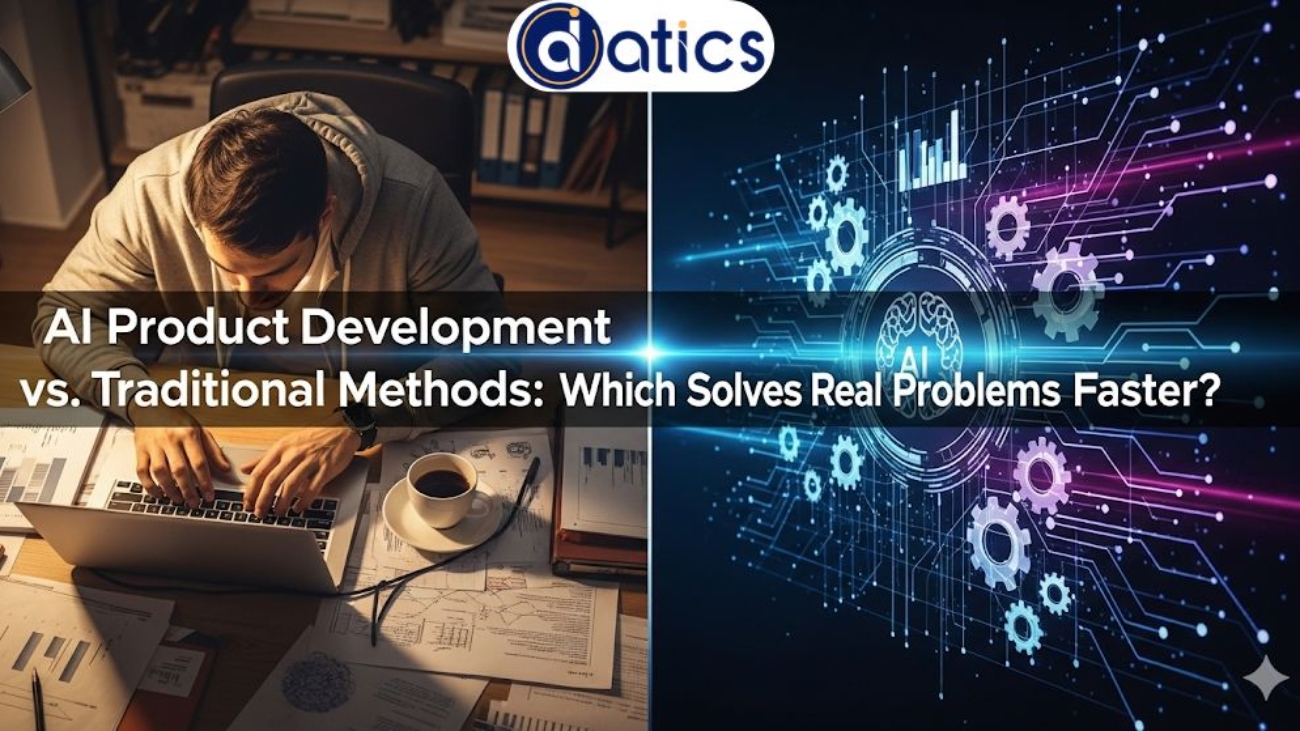
AI Product Development vs. Traditional Methods: Which Solves Real Problems Faster?

In today’s competitive digital landscape, businesses face increasing pressure to deliver software solutions that solve real-world problems faster and more efficiently. While traditional product development methods have long served as the foundation of software creation, AI product development is rapidly reshaping the way organizations innovate, test, and scale. The question many decision-makers ask is simple: which approach actually solves problems faster—AI-driven or traditional?

This article dives deep into the differences, strengths, and limitations of both methods while highlighting how companies can make the right choice depending on their goals.


Understanding Traditional Product Development

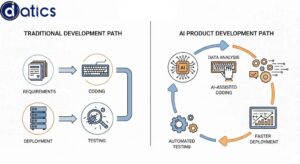
Traditional software development methods rely on a structured, step-by-step process:

  • Requirements gathering
  • Planning and design
  • Coding and implementation
  • Testing and quality assurance
  • Deployment and maintenance

These methods—such as the Waterfall model or even Agile frameworks—are tried and tested. They emphasize stability, documentation, and human decision-making. For industries where precision and compliance matter most (like healthcare or finance), traditional approaches are still highly relevant.

Limitations of Traditional Methods

  • Longer development cycles
  • Higher costs due to extensive manual work
  • Risk of errors discovered late in the process
  • Slower adaptability to changing market needs


What Is AI Product Development?

AI product development integrates machine learning, automation, and advanced analytics into the software lifecycle. Instead of relying solely on human effort, it leverages AI models to accelerate tasks such as:

  • Automated code generation
  • Predictive analytics for product-market fit
  • AI-driven testing and bug detection
  • Intelligent automation in deployment

For businesses looking to innovate quickly, AI Software Development allows faster prototyping, smarter decision-making, and reduced operational overhead.

AI Product Development vs. Traditional Methods: Key Differences

1. Speed of Problem-Solving

  • Traditional: Relies on manual coding, reviews, and iterative testing. Problems are often identified later in the development cycle.
  • AI-Driven: Uses predictive analytics and automation to anticipate and solve issues early. This drastically reduces time-to-market.

2. Adaptability to Market Needs

  • Traditional: Agile frameworks improve flexibility, but constant changes can still increase costs and slow progress.
  • AI-Driven: AI continuously learns from data and user behavior, adapting solutions in real-time.

3. Quality Assurance

  • Traditional: Manual QA processes are time-intensive.
  • AI-Driven: Automated testing uncovers bugs and inefficiencies faster, reducing human error.

4. Scalability

  • Traditional: Scaling requires more developers, infrastructure, and costs.
  • AI-Driven: AI systems can scale without linear increases in human effort, making it more efficient for growing businesses. 

Which Solves Real Problems Faster?

The answer lies in the type of problem being solved.

  • Complex, data-driven challenges: AI product development clearly has the edge. It can process massive datasets, identify patterns, and recommend solutions at a speed humans cannot match.
  • Regulated, compliance-heavy industries: Traditional methods remain vital due to their focus on documentation, control, and structured oversight.

That said, many modern businesses adopt hybrid models, blending AI tools with traditional frameworks to maximize speed, efficiency, and compliance.

Real-World Example of AI Problem-Solving

For instance, businesses struggling with slow product scaling often turn to AI-powered solutions. Instead of manually analyzing customer data, AI predicts usage patterns, identifies bottlenecks, and automates fixes. As outlined in this article on transforming complex problems into scalable solutions, AI development enables companies to move from reactive problem-solving to proactive innovation.

Benefits of Choosing AI Product Development

  • Faster time-to-market with automated code generation
  • Reduced development costs by minimizing manual labor
  • Smarter decision-making powered by real-time insights
  • Improved scalability without exponentially increasing resources
  • Stronger customer experiences through data-driven personalization

When Traditional Methods Still Work Best

  • Projects requiring strict compliance (e.g., legal, healthcare, or government applications
  • Systems with low data dependency where AI may not add significant value
  • Organizations lacking AI infrastructure or expertise

Real-World Example of AI Problem-Solving

For instance, businesses struggling with slow product scaling often turn to AI-powered solutions. Instead of manually analyzing customer data, AI predicts usage patterns, identifies bottlenecks, and automates fixes. AI development enables companies to move from reactive problem-solving to proactive innovation. Companies like Datics.ai, which specialize in AI software development, play a key role in helping organizations adopt these modern practices and address challenges with efficiency.

.

FAQs

1. What is AI product development?

 It’s the integration of artificial intelligence tools and automation into the software lifecycle to accelerate coding, testing, and scaling.

2. Is AI faster than traditional software development?

Yes, AI development is faster for data-heavy, complex problems, but traditional methods still excel in compliance-driven industries.

3. Can AI completely replace traditional development?

Not entirely. The best results often come from combining both approaches.

4. What industries benefit most from AI development?

Tech startups, SaaS, e-commerce, and data-driven industries benefit the most from AI-driven solutions.

5. Is AI product development cost-effective?

Yes, by reducing manual work and automating testing, AI can significantly cut long-term development costs.

Custom software development strategies to enhance hunting efficiency and reduce costs effectively illustrated.

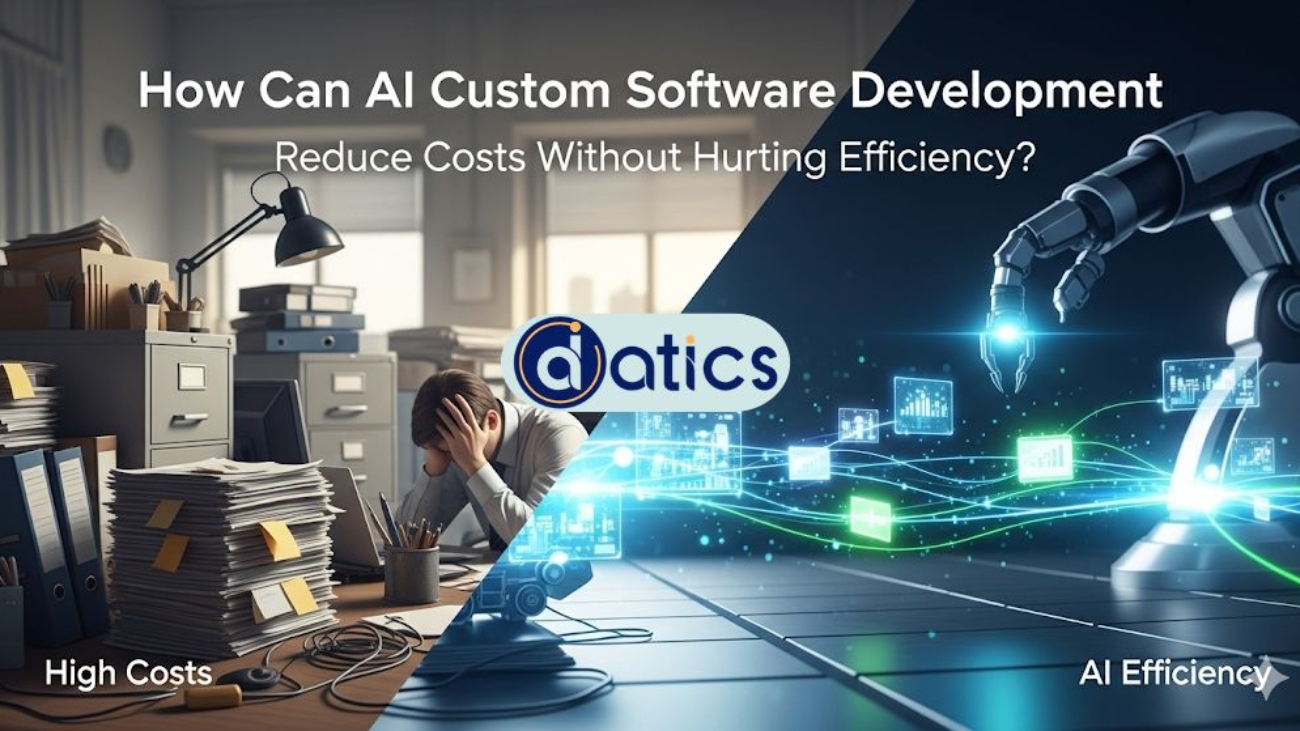
How Can AI Custom Software Development Reduce Costs Without Hurting Efficiency?

Every business today is searching for smarter ways to cut expenses without sacrificing productivity. That’s where AI custom software development steps in. Instead of forcing companies into one-size-fits-all solutions, AI-powered custom systems are designed to fit specific workflows, reduce waste, and deliver automation that improves performance. The result? Lower operational costs without compromising efficiency.

In this article, we’ll explore how businesses can leverage AI software development to solve cost-related challenges, improve decision-making, and stay competitive in today’s fast-paced digital economy.

Why Businesses Struggle With Cost vs. Efficiency

Balancing cost and efficiency is one of the biggest challenges for startups, enterprises, and SaaS providers. Traditional software often leads to:

  • Overhead from unused features 
  • High maintenance costs for generic solutions 
  • Manual inefficiencies that automation could fix 
  • Scaling challenges as the company grows 

The question becomes: How do you cut unnecessary spending while still moving faster than the competition?

This is where AI custom software development plays a transformative role.

How AI Custom Software Development Cuts Costs Without Hurting Efficiency

1. Eliminating Redundant Processes

AI-powered systems identify repetitive workflows and automate them. Tasks like manual data entry, scheduling, and reporting are streamlined—saving both time and salaries spent on non-core activities.

2. Smarter Resource Allocation

AI software ensures resources are used only where needed. By analyzing real-time data, it helps avoid wasted inventory, unnecessary hiring, or under-utilization of assets.

3. Reducing Human Error Costs

Mistakes cost money. AI’s predictive analytics and automation minimize errors in areas like billing, customer data handling, and forecasting, which saves thousands annually.

4. Lower Maintenance and Licensing Fees

Unlike off-the-shelf software with recurring licensing charges, custom-built AI solutions focus only on essential features. This cuts subscription bloat and long-term support costs.

5. Faster Scaling Without Hiring More Staff

AI solutions scale with your business. Instead of hiring large teams, AI can handle repetitive tasks, freeing employees to focus on growth and innovation.

Real-World Example: AI Efficiency in Action

For instance, a U.S.-based SaaS startup struggling with high support costs implemented AI-driven chatbots as part of its custom software. The result? Customer support tickets were reduced by 40%, response times improved, and the company saved thousands in annual staffing.

For more practical insights, you can explore AI software development in action: practical ways it solves today’s biggest issues — a detailed resource on how AI is actively solving modern business challenges.

The Efficiency Advantage: Beyond Cost Cutting

While reducing costs is critical, AI custom software development goes further by:

  • Improving decision-making through predictive analytics
  • Personalizing customer experiences for higher retention
  • Enhancing collaboration with intelligent tools
  • Enabling innovation by freeing resources for R&D 

This dual benefit—cutting costs while boosting performance—is what makes AI software development the most strategic investment for modern businesses.

Common Misconceptions About AI Custom Software

Even though the benefits are clear, some businesses hesitate due to myths:

  • “It’s too expensive to build.” → In reality, long-term savings far outweigh initial investment.
  • “AI will replace employees.” → Instead, it enhances human work by handling repetitive tasks.
  • “Custom software takes too long.” → Agile AI development frameworks allow faster rollouts.

By understanding these misconceptions, companies can make smarter choices about implementing AI solutions.

Best Practices for Implementing AI Custom Software Development

To ensure cost savings and efficiency, businesses should follow these practices:

1. Start With a Clear Problem

Identify specific cost-related issues AI can solve (e.g., manual operations, scaling bottlenecks).

2. Build Scalable Solutions

Develop AI software that grows with the business rather than needing constant redesign.

3. Focus on Integration

AI must integrate seamlessly with existing tools and workflows. Poor integration creates inefficiency.

4. Measure ROI Continuously

Track how much time and money AI saves compared to manual processes.

5. Partner With Experts

Choosing the right AI software development partner ensures better implementation and faster results.

Why AI Custom Software Development is the Future

Businesses that embrace AI today are not just investing in technology—they’re investing in resilience, agility, and long-term sustainability. In an economy where competition is fierce and customer expectations evolve rapidly, relying on outdated, off-the-shelf solutions can hold companies back.

Organizations that fail to adopt AI custom software development often face three major risks:

  • Higher costs from inefficiencies – Manual processes, repetitive tasks, and generic software bloat lead to wasted resources.
  • Falling behind competitors – Businesses leveraging AI automation, predictive analytics, and smart integrations are moving faster and serving customers better.
  • Poor scalability and customer experience – Without flexible, AI-driven systems, companies struggle to grow smoothly and provide seamless digital experiences.

Simply put, AI isn’t just about cost-cutting—it’s about building a future-proof business model.

At Datics AI, we believe the future belongs to companies that integrate AI into the core of their operations. Since 2018, our mission has been to help startups, enterprises, and SaaS providers harness the power of AI software development to cut unnecessary costs while driving innovation and efficiency.

Our team specializes in:

  • Building custom AI solutions that align with your exact business goals
  • Integrating automation to eliminate redundancy and accelerate workflows
  • Designing scalable systems that grow as your business expands
  • Ensuring efficiency without compromising on quality or customer satisfaction

By choosing Datics AI, you’re not just implementing a piece of software—you’re adopting a partner dedicated to shaping your business into a lean, innovative, and future-ready organization.

The future of software isn’t generic. It’s AI-driven, custom-built, and strategically aligned with each business’s unique challenges. Companies that take this step today will be the leaders of tomorrow.

FAQs

1. How does AI custom software reduce operational costs?

By automating repetitive tasks, minimizing errors, and cutting licensing fees.

2. Is AI software development only for large enterprises?

No, startups and SMEs benefit equally by saving resources and scaling faster.

3. Does AI software replace employees?

No—it enhances human efficiency by handling repetitive or data-heavy tasks.

4. What industries benefit most from AI software development?

Healthcare, SaaS, retail, finance, and logistics are leading adopters.

5. How quickly can businesses see ROI from AI software?

Most companies start noticing measurable savings within 6–12 months.

Author Bio

Written by the Datics AI editorial team, experts in AI software development and digital transformation. With years of experience helping businesses cut costs and scale efficiently, our mission is to share trusted insights that empower smarter decisions.

A split-image illustration: one side showing modern challenges (fraud, healthcare, traffic), the other side showing AI “networks” untangling and solving them in real time.

AI Software Development in Action: Practical Ways It Solves Today’s Biggest Issues

The biggest challenges businesses face today—whether it’s handling data overload, customer demands, fraud risks, or global disruptions—cannot be solved by traditional software alone. Systems built on static rules fail when problems scale, evolve, or take new shapes.

This is where AI Software Development proves its value. By combining automation, machine learning, and predictive intelligence, AI-powered software doesn’t just fix problems temporarily—it builds solutions that are scalable, adaptive, and long-lasting.

Why Today’s Issues Need AI at the Core

We’re living in a time where every sector faces problems that feel too big, too fast, and too complex:

  • Healthcare struggling with patient data and early diagnosis.
  • Finance fighting fraud and compliance risks in real time.
  • Retail balancing unpredictable demand shifts.
  • Education needing personalized learning for millions of students.

Traditional systems can’t keep up. AI software development works differently—it learns from data, adapts to change, and scales automatically, turning what seems impossible into manageable solutions.

Practical Ways AI Software Development Solves Today’s Biggest Issues

1. Fraud and Security Threats

Cybercrime costs businesses trillions globally. Static security tools are no match for evolving fraud tactics. AI steps in with anomaly detection algorithms that monitor millions of transactions simultaneously, flagging suspicious behavior instantly.
👉 Banks, e-commerce platforms, and fintech companies now rely on AI-driven fraud detection to stay one step ahead of attackers.

2. Healthcare Diagnosis and Patient Care

Doctors face overwhelming amounts of patient data, medical histories, and imaging scans. AI software cuts through the complexity by:

  • Scanning X-rays and MRIs for hidden anomalies.
  • Predicting patient risks based on historical patterns.
  • Supporting doctors in making quicker, data-backed decisions.

This makes diagnosis faster, more accurate, and scalable across entire hospital systems.

3. Personalized Education at Scale

Students learn at different paces, yet traditional education delivers the same curriculum for all. AI solves this by creating adaptive learning platforms that respond to each learner’s progress.

For example, here’s a detailed breakdown: How AI Education Software Integrates with Existing LMS Effectively. This shows how AI can seamlessly blend with LMS platforms, ensuring students get personalized, scalable, and engaging education experiences.

4. Customer Experience and Engagement

Customers expect instant responses, tailored recommendations, and consistent service across platforms. AI-powered chatbots, recommendation engines, and predictive analytics deliver this at scale—whether it’s helping millions of users simultaneously or personalizing a single experience.

5. Supply Chain and Logistics Optimization

Unpredictable weather, traffic, and market fluctuations can break even the best supply chain models. AI solves this by:

  • Predicting demand surges before they happen.
  • Optimizing delivery routes in real time.
  • Reducing costs while maintaining reliability.

This turns global supply chains from fragile systems into resilient, scalable networks.

The Human Side of AI: Empowering People, Not Replacing Them

One of the biggest misconceptions is that AI replaces humans. In reality, AI software development empowers teams:

  • Doctors spend less time on admin tasks, more time with patients.
  • Teachers focus on mentorship, while AI handles adaptive grading.
  • Customer service agents solve complex queries, while AI resolves routine ones.

It’s not about replacing jobs—it’s about reshaping them for greater impact.

Looking Ahead: The Future of AI in Problem-Solving

We’re moving toward a future where AI isn’t just a tool—it’s the foundation of problem-solving. Tomorrow’s AI solutions will:

  • Model climate change at regional and city-wide levels.
  • Deliver fully personalized medicine tailored to each person’s DNA.
  • Manage smart cities with adaptive traffic and energy systems.

Companies like Datics.ai are at the forefront of this shift, helping businesses embrace AI-driven software development to tackle issues that once felt unsolvable. AI will continue to be about solving human problems with scalable, intelligent solutions.

Conclusion: From Issues to Opportunities

AI software development has moved from concept to action. Whether it’s stopping fraud, improving healthcare, personalizing education, or optimizing supply chains, AI is proving its power to solve today’s biggest issues at scale.

For businesses navigating complex challenges, the answer is no longer to patch problems with outdated tools. It’s to embrace AI as a partner in problem-solving—turning issues into opportunities for growth, resilience, and innovation.

FAQs

  1. What problems does AI software development solve best?
    Fraud detection, healthcare diagnostics, supply chain optimization, and personalized customer experiences.
  2. How does AI scale solutions for businesses?
    AI adapts to workload increases automatically, ensuring reliability from 100 users to millions.
  3. Is AI software only for large enterprises?
    No. Cloud-based AI tools make it accessible for startups and SMEs at affordable levels.
  4. How does AI integrate with old systems?
    Through APIs and middleware that allow AI to connect without rebuilding everything from scratch.
  5. Does AI replace human jobs?
    Not directly—it removes repetitive tasks and empowers humans to focus on higher-value work.