
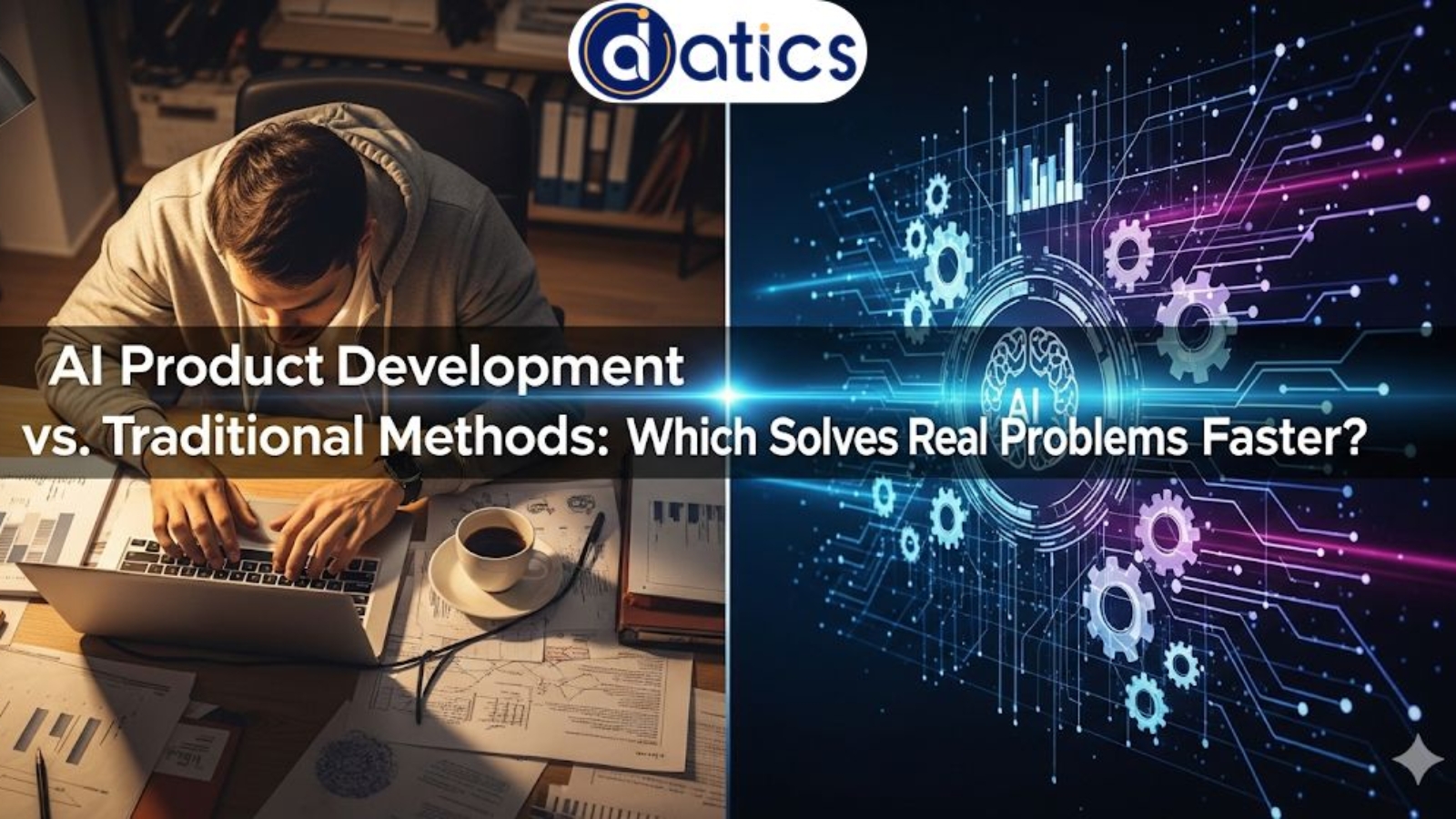
In today’s competitive digital landscape, businesses face increasing pressure to deliver software solutions that solve real-world problems faster and more efficiently. While traditional product development methods have long served as the foundation of software creation, AI product development is rapidly reshaping the way organizations innovate, test, and scale. The question many decision-makers ask is simple: which approach actually solves problems faster—AI-driven or traditional?
This article dives deep into the differences, strengths, and limitations of both methods while highlighting how companies can make the right choice depending on their goals.
Understanding Traditional Product Development
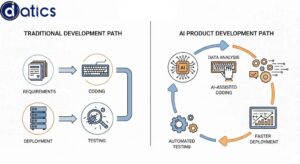
Traditional software development methods rely on a structured, step-by-step process:
- Requirements gathering
- Planning and design
- Coding and implementation
- Testing and quality assurance
- Deployment and maintenance
These methods—such as the Waterfall model or even Agile frameworks—are tried and tested. They emphasize stability, documentation, and human decision-making. For industries where precision and compliance matter most (like healthcare or finance), traditional approaches are still highly relevant.
Limitations of Traditional Methods
- Longer development cycles
- Higher costs due to extensive manual work
- Risk of errors discovered late in the process
- Slower adaptability to changing market needs
What Is AI Product Development?
AI product development integrates machine learning, automation, and advanced analytics into the software lifecycle. Instead of relying solely on human effort, it leverages AI models to accelerate tasks such as:
- Automated code generation
- Predictive analytics for product-market fit
- AI-driven testing and bug detection
- Intelligent automation in deployment
For businesses looking to innovate quickly, AI Software Development allows faster prototyping, smarter decision-making, and reduced operational overhead.
AI Product Development vs. Traditional Methods: Key Differences
1. Speed of Problem-Solving
- Traditional: Relies on manual coding, reviews, and iterative testing. Problems are often identified later in the development cycle.
- AI-Driven: Uses predictive analytics and automation to anticipate and solve issues early. This drastically reduces time-to-market.
2. Adaptability to Market Needs
- Traditional: Agile frameworks improve flexibility, but constant changes can still increase costs and slow progress.
- AI-Driven: AI continuously learns from data and user behavior, adapting solutions in real-time.
3. Quality Assurance
- Traditional: Manual QA processes are time-intensive.
- AI-Driven: Automated testing uncovers bugs and inefficiencies faster, reducing human error.
4. Scalability
- Traditional: Scaling requires more developers, infrastructure, and costs.
- AI-Driven: AI systems can scale without linear increases in human effort, making it more efficient for growing businesses.
Which Solves Real Problems Faster?
The answer lies in the type of problem being solved.
- Complex, data-driven challenges: AI product development clearly has the edge. It can process massive datasets, identify patterns, and recommend solutions at a speed humans cannot match.
- Regulated, compliance-heavy industries: Traditional methods remain vital due to their focus on documentation, control, and structured oversight.
That said, many modern businesses adopt hybrid models, blending AI tools with traditional frameworks to maximize speed, efficiency, and compliance.
Real-World Example of AI Problem-Solving
For instance, businesses struggling with slow product scaling often turn to AI-powered solutions. Instead of manually analyzing customer data, AI predicts usage patterns, identifies bottlenecks, and automates fixes. As outlined in this article on transforming complex problems into scalable solutions, AI development enables companies to move from reactive problem-solving to proactive innovation.
Benefits of Choosing AI Product Development
- Faster time-to-market with automated code generation
- Reduced development costs by minimizing manual labor
- Smarter decision-making powered by real-time insights
- Improved scalability without exponentially increasing resources
- Stronger customer experiences through data-driven personalization
When Traditional Methods Still Work Best
- Projects requiring strict compliance (e.g., legal, healthcare, or government applications
- Systems with low data dependency where AI may not add significant value
- Organizations lacking AI infrastructure or expertise
Real-World Example of AI Problem-Solving
For instance, businesses struggling with slow product scaling often turn to AI-powered solutions. Instead of manually analyzing customer data, AI predicts usage patterns, identifies bottlenecks, and automates fixes. AI development enables companies to move from reactive problem-solving to proactive innovation. Companies like Datics.ai, which specialize in AI software development, play a key role in helping organizations adopt these modern practices and address challenges with efficiency.
.
FAQs
1. What is AI product development?
It’s the integration of artificial intelligence tools and automation into the software lifecycle to accelerate coding, testing, and scaling.
2. Is AI faster than traditional software development?
Yes, AI development is faster for data-heavy, complex problems, but traditional methods still excel in compliance-driven industries.
3. Can AI completely replace traditional development?
Not entirely. The best results often come from combining both approaches.
4. What industries benefit most from AI development?
Tech startups, SaaS, e-commerce, and data-driven industries benefit the most from AI-driven solutions.
5. Is AI product development cost-effective?
Yes, by reducing manual work and automating testing, AI can significantly cut long-term development costs.


